Solving Exponential Equations With Logarithms
hive-163521·@dkmathstats·
0.000 HBDSolving Exponential Equations With Logarithms
Hi there. In this mathematics post, I cover the concept of solving exponential equations with the use of logarithms. This is a technical algebra/calculus topic. It is assumed that the reader is familiar with exponents and logarithm basics. For the math text I use a combination of QuickLatex.com, witeboard.com and my Wacom stylus and writing tablet. <center><img src="https://cdn.pixabay.com/photo/2015/10/11/11/20/banner-982162_960_720.jpg" /></center> <center><a href="https://cdn.pixabay.com/photo/2015/10/11/11/20/banner-982162_960_720.jpg">Pixabay Image Source</a></center> ## Review of Logarithms --- Before I get into solving exponential equations with the use of logarithms, I think it is a good idea to do a short review on logarithms. The logarithm can be viewed as an exponent when it comes to solve exponential questions like <center>Two to the power of x is equal to 32: https://quicklatex.com/cache3/3c/ql_8fede80e2da8572b25772dadc3cbf93c_l3.png</center> <center>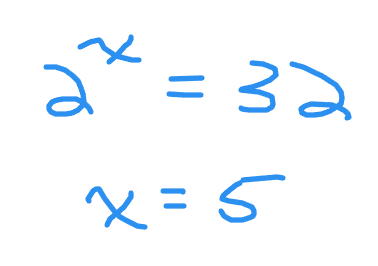</center> For this question the answer is 5 as to the power of 5 is 32. **Logarithm Properties** There are algebra properties with logarithms. I feature three of the common properties. 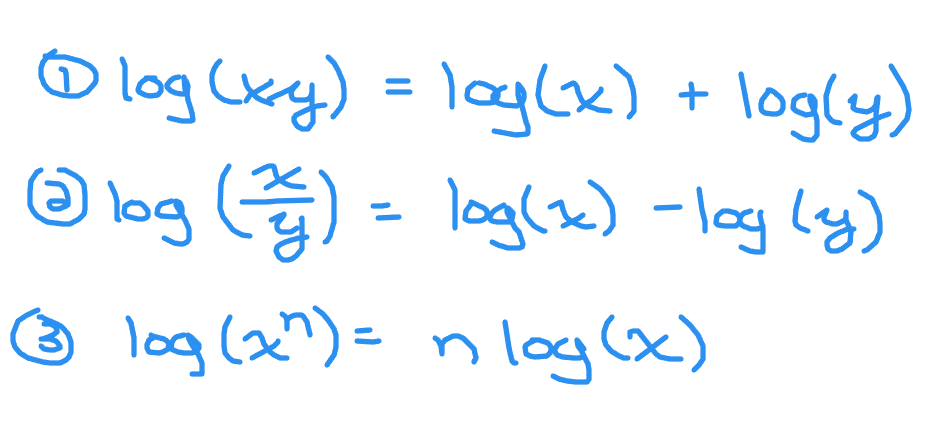 The logarithm property that is featured when it comes to solving logarithms is the third one above. That is the exponent in the input of the logarithm can be moved to the front of the logarithm. <center><img src="https://cdn.pixabay.com/photo/2020/02/17/09/15/board-4855963_960_720.jpg" /></center> <center><a href="https://cdn.pixabay.com/photo/2020/02/17/09/15/board-4855963_960_720.jpg">Pixabay Image Source</a></center> ## Examples --- **Example One** Determine the value of `x` in https://quicklatex.com/cache3/4c/ql_ca5abf4aabeded1d74c29b2687e5134c_l3.png. 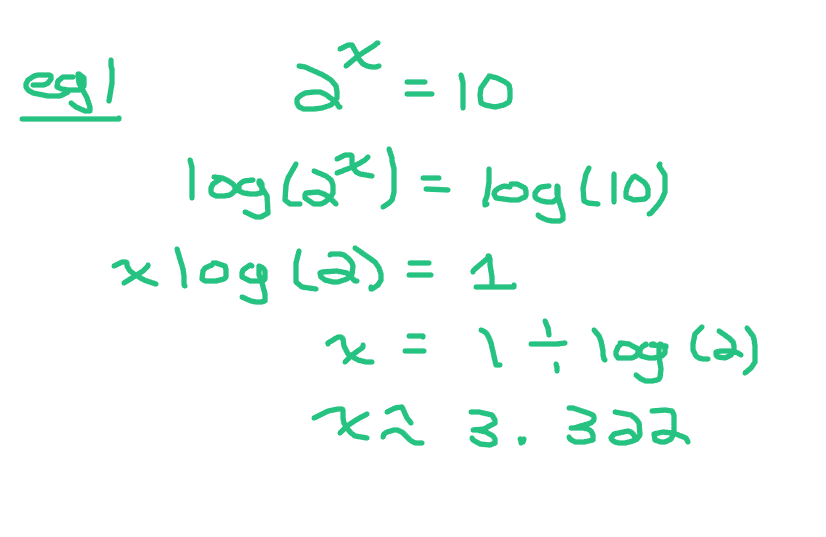 For this question logarithms are needed as it is not obvious what the value of `x` is in two to the power of `x` equals ten. Two to the power of 1 is 2, two to the power of two is 4, two with and exponent of 3 is 8 and two to the power of four is 16. The answer is somewhere between 3 and 4. Take the logarithm of both sides to start. Then solve for `x`. See the screenshot below for details. Note that the logarithm of 10 is one as ten to the power of 1 is 10. Assume base ten for logarithms if there is no subscript. **Example Two** What is `x` in ten to the power of `x` equal to 200? That is https://quicklatex.com/cache3/e2/ql_860194f873afe39440fcfb49ae4629e2_l3.png. 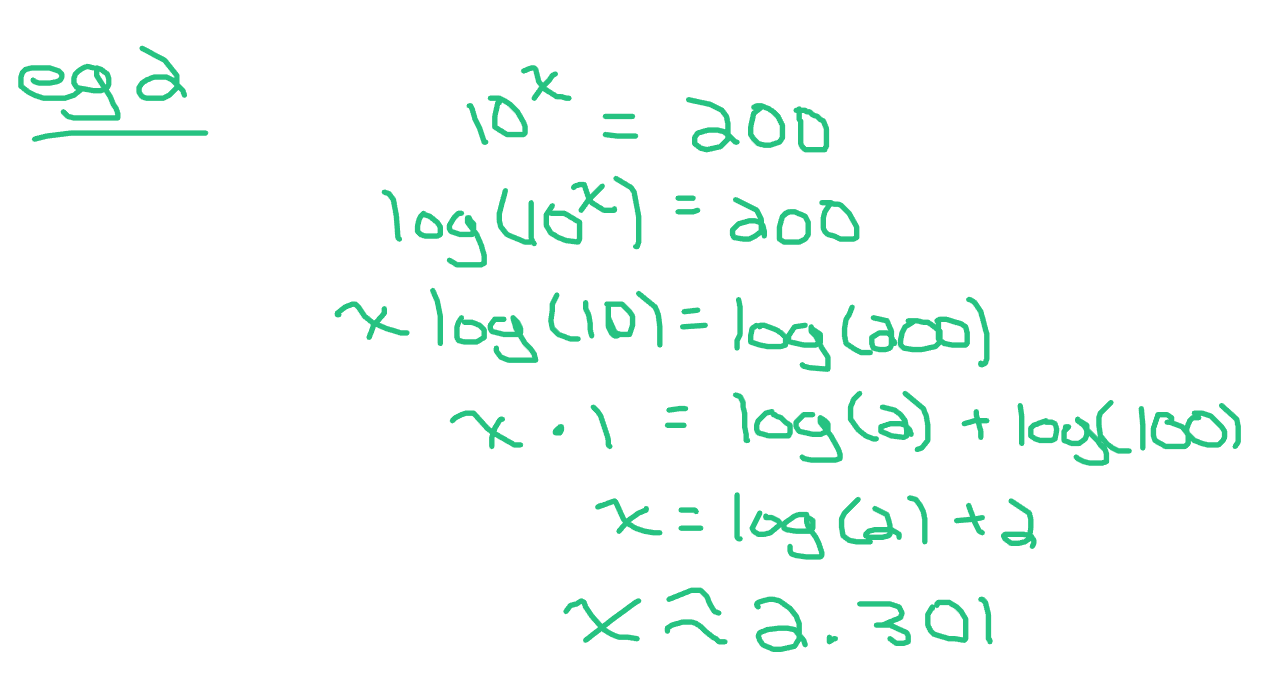 To start take the logarithm of ten to the power of `x` on the left side and take the logarithm of 200 on the right side. Use the power rule property on the left side to move the exponent `x` in front of the logarithm of 10. The logarithm of 10 is 1 if the base is 10. The answer here is the logarithm of 200 which is about 2.301. **Example Three** What is the value of `x` in one half to the power of `x` equal to 5? That is https://quicklatex.com/cache3/cd/ql_5563bc02c30af0830e01e435f5f759cd_l3.png 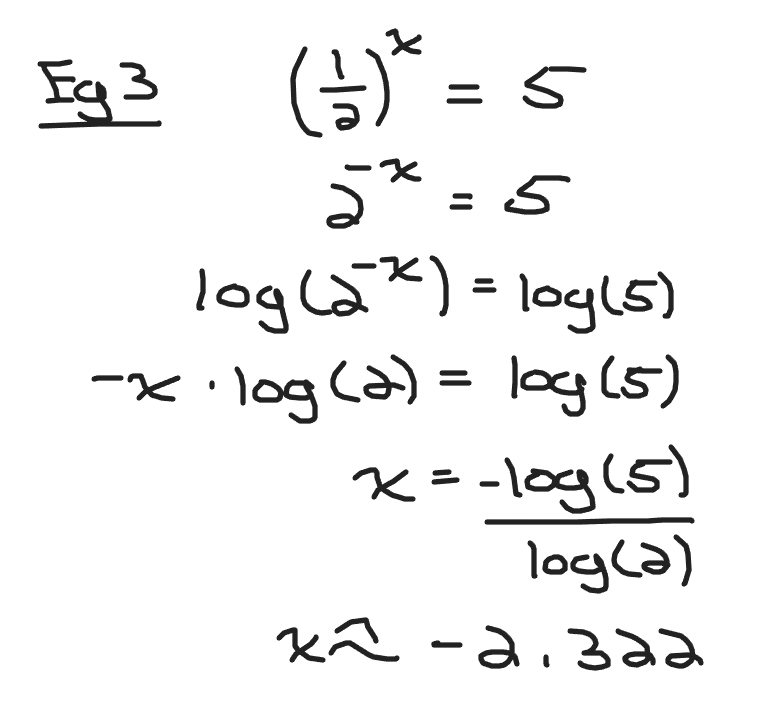 Rewrite the one half as two to the power of negative one. The left side becomes two to the power of negative x. Take the logarithm in both sides. The left side would be the logarithm of two to the power of negative `x`. The right side is the logarithm of five. From the power rule property for logarithms move the negative `x` to the front of the logarithm. Divide both sides by the negative logarithm of two. The answer for x is negative logarithm of 5 divided by the logarithm of 2. This is approximately `-2.322`. **Example Four** In seven times three to the power of `2x` equal to 70 what is the value of `x`? That is what is `x` in https://quicklatex.com/cache3/03/ql_c395d2d3c4deb2fe61471d87fdac6203_l3.png ?  Start with dividing both sides by seven. The left is side is three to the power of `2x` with the right side being 10. Take the logarithm in both sides. In the left side move the `2x` exponent to the front of the logarithm. On the right side the logarithm of 10 is 1. Divide both sides by twice the logarithm of 3. The value of `x` is 1 divided by 2 log 3. This is approximately 1.048. 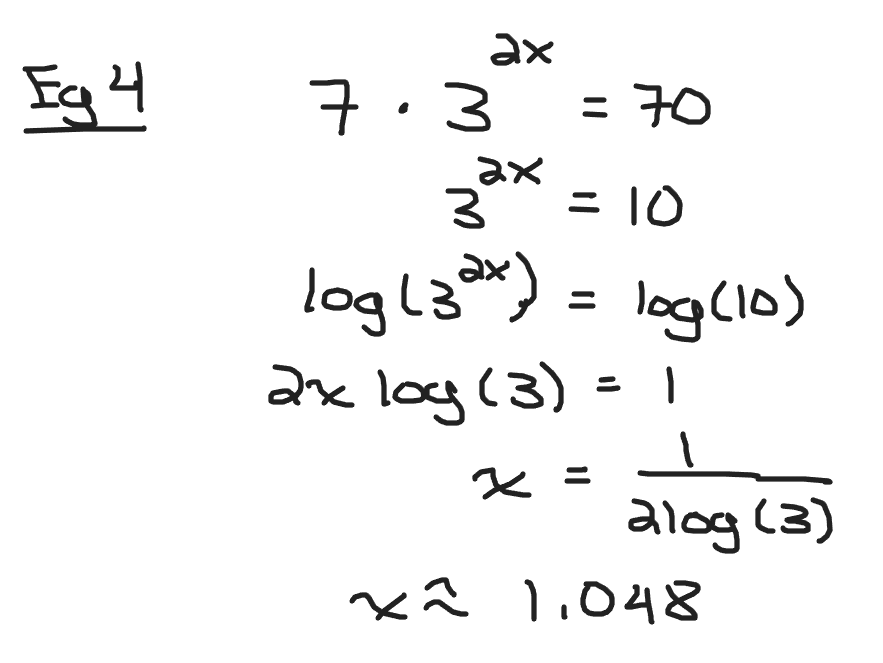 <center><img src="https://cdn.pixabay.com/photo/2015/11/05/08/20/geometry-1023843_960_720.jpg" /></center> <center><a href="https://cdn.pixabay.com/photo/2015/11/05/08/20/geometry-1023843_960_720.jpg">Pixabay Image Source</a></center> <center>Thank you for reading.</center> Posted with [STEMGeeks](https://stemgeeks.net)
👍 klye, khalstem, stemcur, slider2990, voter, eturnerx, morwen, nenya, klima, nijn, quenty, nimloth, scholaris.stem, meestemboom, drifter1, limka, acont, nnurdiani, enforcer48, steemseph, adamada, jazzhero, sgbonus, bestofph, pinas, anonymous02, holovision.stem, zuerich, irivers, abh12345.stem, dorkpower, babytarazkp, sillybilly, discovery-it, spiceboyz, ciuoto, popurri, marcolino76, jacopo.eth, pab.ink, sbarandelli, vittoriozuccala, spaghettiscience, phage93, lallo, samuel.steem, stregamorgana, meeplecomposer, maruskina, victoriaxl, capitanonema, damaskinus, axel-blaze, hjmarseille, ghastlygames, bindalove, repayme4568, krrizjos18, mattbrown.art, yoieuqudniram, dimascastillo90, jrjaime, lukasbachofner, gianluccio, carolineschell, straykat, piumadoro, mad-runner, cooltivar, nattybongo, armandosodano, coccodema, middleearth, adinapoli, juanbg, titti, maryincryptoland, tinyhousecryptos, omodei, discovery-blog, disagio.gang, peterpanpan, meppij, matteus57, joseq1570, flewsplash, jilt, yggdrasilwind, kkartdesign, maridmc, farmingtales, cryptogillone, castles, lyamalfonzo23, david.steem, mukadder, carolinaes, darthgexe, ultima-alianza, maiu, admiralbot, aninsidejob, memehub, steemflagrewards, doodle.danga, denisda, serialfiller, cooperfelix, donatello, lorenzopistolesi, romytokic, chapmain, stea90, joseluis91, martthesquire, yggdrasil.laguna, stemgeeks, adamada.stem, solominer.stem, stemcuration, saboin.stem, stuntman.mike, penned-bullshit, brofund-stem, stemline, star.stem, scooter77.stem, juecoree, peerfinance, lemouth, steemstem-trig, steemstem, dna-replication, roelandp, stemsocial, minnowbooster, aboutcoolscience, robotics101, sco, alexdory, de-stem, temitayo-pelumi, zeruxanime, kqaosphreak, lamouthe, curie, edb, valth, oluwatobiloba, tsoldovieri, abigail-dantes, sandracarrascal, pboulet, stem.witness, alexander.alexis, techslut, walterjay, dhimmel, sustainablyyours, samminator, kenadis, madridbg, intrepidphotos, gadrian, plicc8, metabs, aidefr, bhoa, fragmentarion, geopolis, melvin7, francostem, deholt, crowdwitness, noelyss, doctor-cog-diss, pedrobrito2004, stayoutoftherz, talentclub, deriyon, enzor, drawmeaship, bflanagin, juancar347, oscarina, thecryptodrive, trenz, fineartnow, jacuzzi, qwerrie, cnfund, neumannsalva, cloh76, brotherhood, cleanplanet, bscrypto, steemcryptosicko, bitrocker2020, cheese4ead, mamalikh13, gregan, otp-one, dcrops, cleanyourcity, pandasquad, brianoflondon, aries90, yann0975, maverickfoo, kristall97, hiveonboard, citizendog, podping, sunsea, neneandy, movingman, gohive, irgendwo, kylealex, r-nyn, greddyforce, the100, aabcent, iansart, metroair, maxdevalue, tanzil2024, the-burn, bloghound, steemstorage, princessmewmew, qberry, therising, aicu, detlev, meno, yixn, revo, therealwolf, dawnoner, baltai, utube, smartsteem, gogreenbuddy, cakemonster, steemean, roamingsparrow, arunava, investingpennies, gunthertopp, justyy, onewolfe, zyx066, communitybank, sportscontest, fantasycrypto, superlotto, meritocracy, empath, punchline, federacion45, steemwizards, drricksanchez, thelittlebank, monica-ene, netaterra, dynamicrypto, tfeldman, technologix, rt395, jayna, musicvoter2, traderhive, therealyme, steveconnor, diabonua, xeldal, mcsvi, meanbees, adol, enki, xxeldal, forykw, sanderjansenart, mafufuma, carilinger, grapthar, atheistrepublic, dondido, lightpaintershub, jerrybanfield, lordvader, stem-espanol, lorenzor, analealsuarez, iamphysical, azulear, miguelangel2801, tomastonyperez, elvigia, josedelacruz, andrick, uche-nna, fran.frey, giulyfarci52, psicoluigi, mammasitta, dandays, nfttunz, eric-boucher, robertbira, nicole-st, flatman, ennyta, endopediatria, stem-shturm, stem.alfa, gamersclassified, krishu.stem, moraviareosa, davidesimoncini,