Electrical Component Basics: The Inductor
steemstem·@proteus-h·
0.000 HBDElectrical Component Basics: The Inductor
Closer to the basics today with an introduction to the inductor, one of the fundamental passive electrical components. An inductor uses a magnetic field to store energy and as such has some interesting properties. The inductor is extremely important for things like filtering, changing voltages, and manipulating magnetic fields.  *Inductor Circuit Symbol* *[Credit](https://commons.wikimedia.org/wiki/File:Inductor.svg)* ## What is an inductor? Inductors are typically nothing more than coils of wire. If you run electrical current through a long, straight wire, a magnetic field will form around the wire, looking something like this: 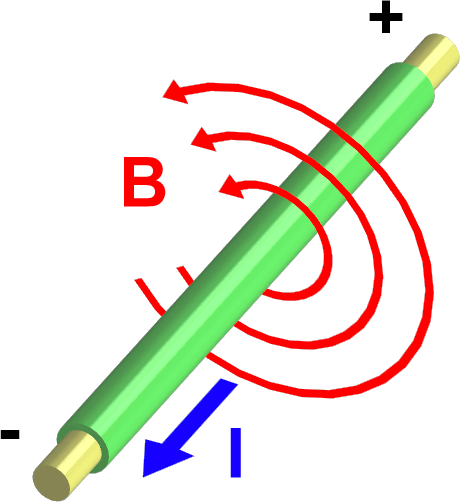 *[Credit](https://commons.wikimedia.org/wiki/File:Electromagnetism.png)* If you coil up the wire, the field changes. Since the wire is now forming a series of circular loops down the coil, the magnetic field produced by each part of the wire adds in the center of coil, creating a straight-line magnetic field that goes down the center of the coil. Stacking more and more loops makes the field inside the coil closer and closer to a constant field pointing up through the coil. An infinite coil of wire (or solenoid) would have a constant field everywhere inside the coil and no magnetic field at all outside the coil. Since nothing we can make is infinite, the coil will still create a magnetic field outside as well as inside. 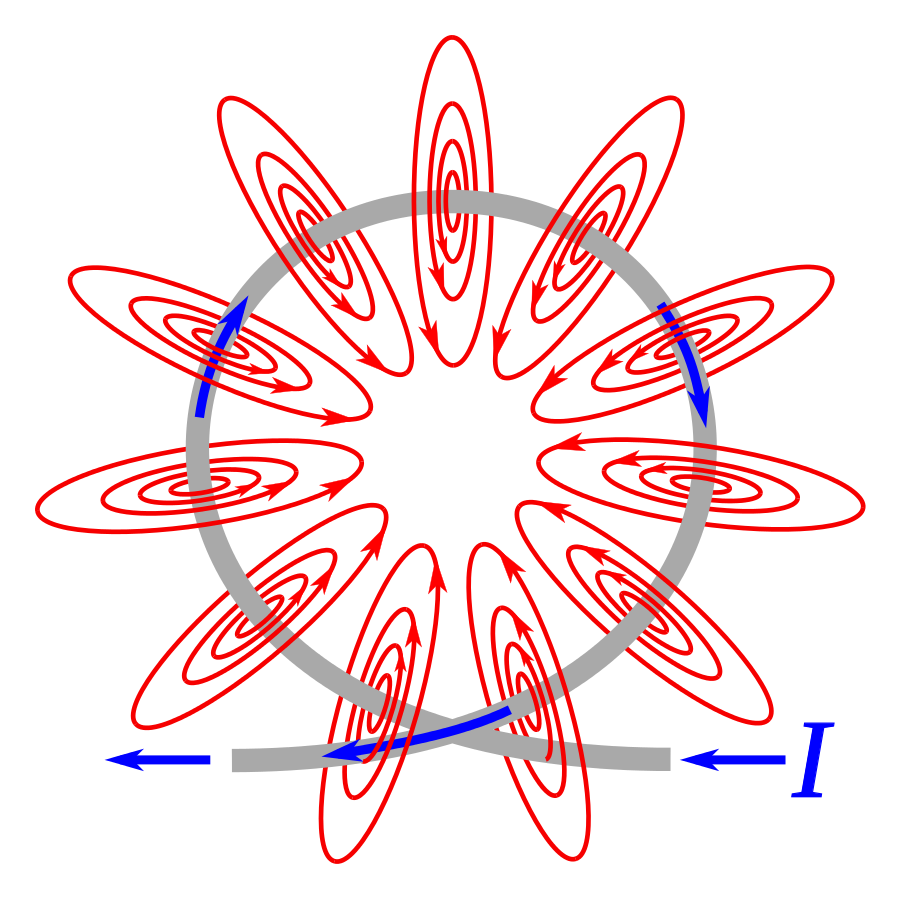 *Magnetic field of a loop of wire* *[Credit](https://commons.wikimedia.org/wiki/File:Magnetic_field_of_wire_loop.svg)* But building up that magnetic field within the coil actually stores electrical energy in the newly created magnetic field. As long as the field persists, energy is stored there. Turn off the coil and that energy comes into play. Say you have a coil of wire with current flowing through it. The magnetic field inside the coil has fully built up to its maximum level. Now, disconnect the battery powering the coil. Something called [Faraday's Law of Electromagnetic Induction](https://steemit.com/electromagnetism/@proteus-h/faraday-s-law-of-electromagnetic-induction) now changes the picture. When the battery is disconnected, the current in the coil rapidly drops off. This causes the magnetic field to collapse. But, the collapsing magnetic field is now a *changing* magnetic field. Faraday's Law says that *changing* magnetic flux induces a voltage difference, and in this case, the decreasing magnetic field is certainly causing a change in magnetic flux. The effect of Faraday's Law is that the inductor coil tries to "cancel out" the change in magnetic flux by inducing a current in the coil that tries to prop up the dying magnetic field. What this means is that disconnecting an inductor turns it into its own voltage source, sort of like a weird "battery", for a short period of time. Faraday's Law means that a disconnected inductor will generate a voltage across itself to drive current through the inductor and try to maintain the magnetic field. The field and currents eventually go to zero, of course, but the energy *stored in the magnetic field* is used here to drive currents through the coil. ## What an Inductor Does Faraday's Law gives the inductor a strange property: The voltage generated by an inductor depends on how the current through it changes. The basic inductor equation is given by the following: **V = -L * dI/dt** This just means that the voltage generated by any inductor is equal to the *rate of change* of the electrical current through the coil multiplied by a constant value called "Inductance" (Inductance is usually constant for any given inductor). When you unplug an inductor, the rate of change is current is very high (you just turned it off!). When an inductor is just running current after being plugged in for awhile, dI/dt = 0 since the current is constant. 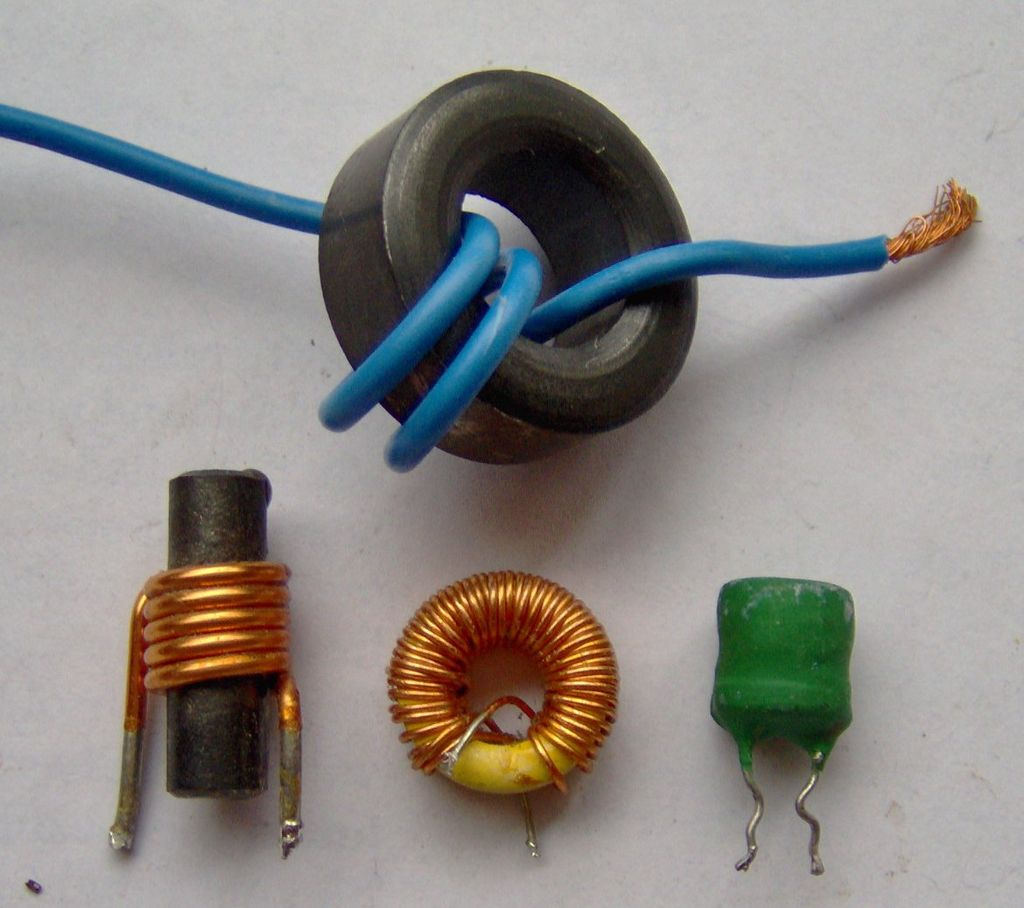 *Various types of inductors. You can easily find and remove these coils in all kinds of electronics.* *[Credit](https://commons.wikimedia.org/wiki/Inductor#/media/File:Electronic_component_inductors.jpg)* As such, an inductor will produce its own voltage difference when it plugged in or unplugged. The faster you turn on an inductor (or unplug it), the greater the voltage spike will be. This voltage spike can be really high - high enough to ionize air and create a plasma arc (spark gap). This is what happens if you unplug something really fast and hear a crack. Just today I was messing around with a relay (trying to get that transmitter working, which is still a work in progress) oscillator. Since the relay controller is just a giant inductor, when it is turned off every 1/10 of a second a big voltage spike is produced. If I held the relay while it was oscillating and touched one of the inductor pins, I received an annoying shock. This voltage difference can be harmful or annoying (see the relay shock), but it can also be useful. For example, you can make an extremely similar voltage boosting circuit with an inductor and a diode. Press a button over and over to repeatedly cut off current to the inductor to produce large voltage spikes that pass through the diode and charge a capacitor. Actual automatic boost converters use inductors in a similar way to produce larger voltages out than in (of course, by conservation of energy, the output current will be correspondingly less). ## Uses for Inductors Other than the aforementioned boost converter, inductors have a few other uses. Taking boost converters to the extreme, they can be used to produce electric arcs, like on the high voltage lighter I took apart previously. Put two inductors around each other and you have a (very crude) *transformer*, a device that can step up (or down) alternating current voltages. A transformer can take 120 Volts AC from your wall and step it down to 5 Volts AC for your USB wall charger, or up to 2000 Volts AC to power the magnetron transmitter in your microwave oven. Transformers are extremely simple ways to change voltages without needing a bunch of supporting circuitry (although you will need to a way to get to and from AC voltages). 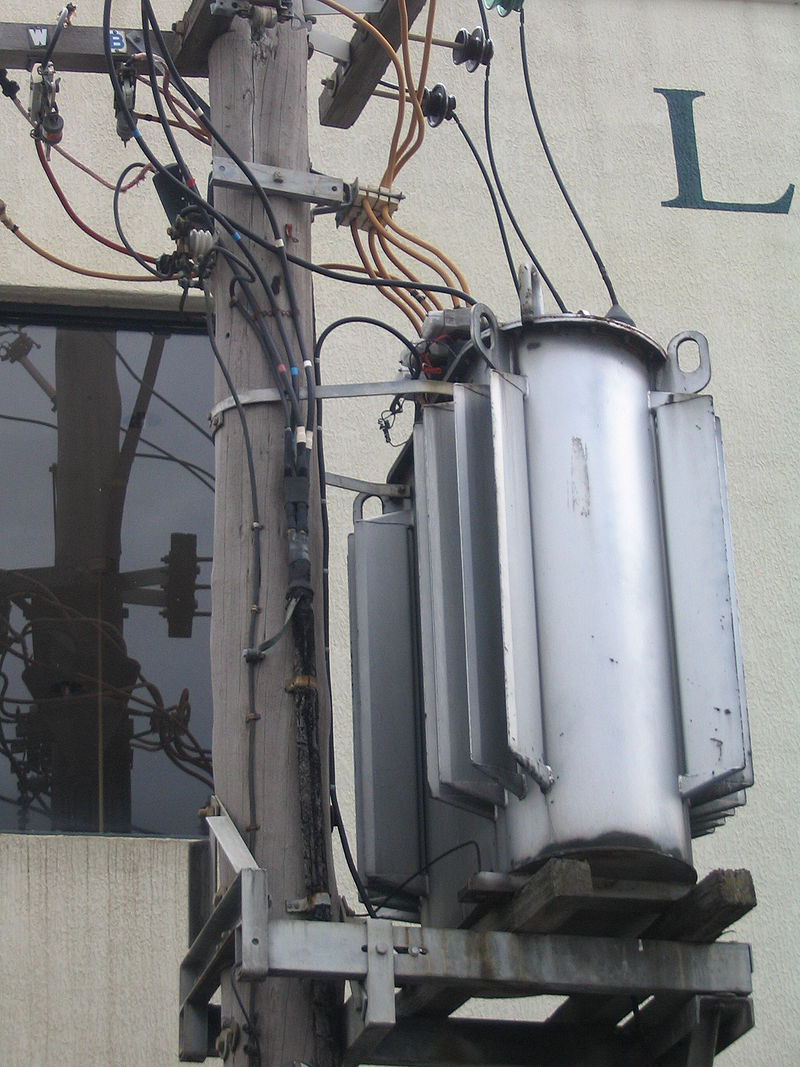 *Large transformer on a power line pole* *[Credit](https://commons.wikimedia.org/wiki/Transformer#/media/File:Transformer_in_Melbourne.jpg)* Inductors can also be used to filter electrical pulses. The higher the frequency of an electric signal is, the more an inductor will resist passing current through it in response to said signal. Placing a large inductor on the output of a circuit will then block many of the high-frequency components of the output signal (a type of *low-pass filter*). You can also use inductors as artificial magnets. Like in relays, connect a battery to a really big inductor and the magnetic field will be strong enough to let the inductor pick up magnetizable stuff like nails, screws, and staples. This is an electromagnet, and they can be used on large scales in things like door locks and scrapyards. An easy way to raise the inductance of your inductor coil and make it easier to pick up things magnetically is to add an iron (or other magnetizable material) core inside the coil. 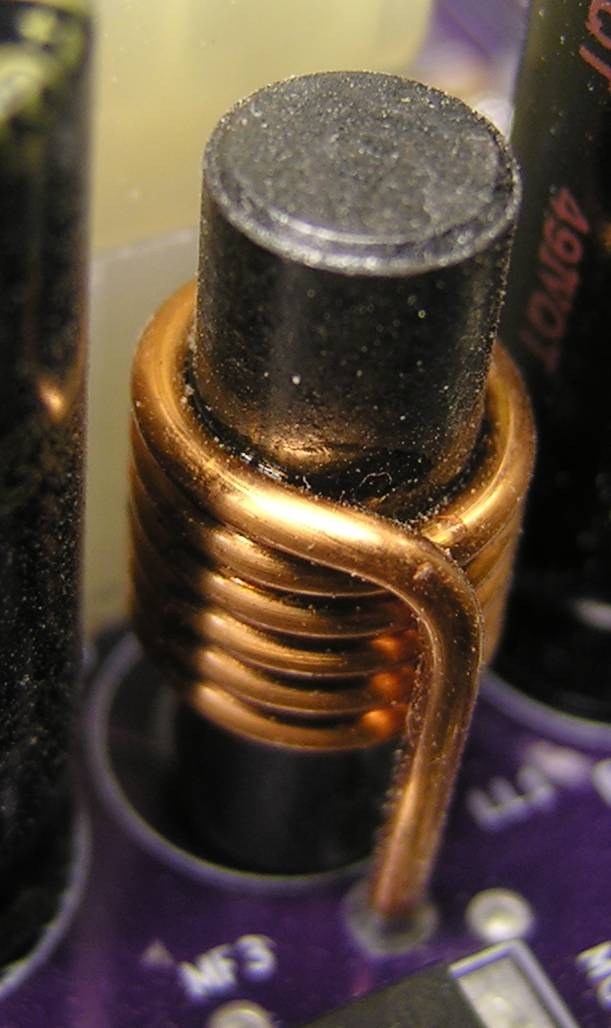 *Ferrite core inductor in place on a board* *[Credit](https://commons.wikimedia.org/wiki/Inductor#/media/File:Inductor.jpg)* Finally, inductors can be used to make really crude radio-wave transmitters. Put an inductor next to a capacitor (which stores energy in an *electric* field by storing charges) and electric charge will oscillate between the two, forming an alternating current signal that dies out after a bit due to resistance in the wires. If you hook up an antenna to this oscillator, you have a really bad transmitter that works on a frequency determined by the inductor and capacitor (see my spark-gap transmitter post [here](https://steemit.com/steemstem/@proteus-h/diy-spark-gap-radio-transmitter-and-explanation) for a poorly executed example of this). This kind of LC circuit also makes a useful filtering circuit, and a modified version lets you transmit your voice, FM modulated, over radio waves. Of course, there are many other uses for inductors, but the ones above will get you a decent summary. Inductors are an essential electrical component and will be found in almost any electronic device. It's important to have at least a little knowledge of them if you want to effectively mess around with electronics for fun like I do. ______________________________________________________ If you have questions, comments, or corrections, do not hesitate to let me know. *Thanks for reading!* **Additional Reading:** [Electronics Tutorials: Inductance of a Coil](https://www.electronics-tutorials.ws/inductor/inductance.html)
👍 proteus-h, onderakcaalan, synergysteem, tauseefkhan, bachuslib, mathowl, anomaly, bloom, mcw, technology-trail, terrylovejoy, gunsmithing, shaka, betelzeus, lunanightshade, smasher, intuitivelearner, sese317j, lemouth, steemstem, anarchyhasnogods, justtryme90, the-devil, mobbs, foundation, lamouthe, himal, nitesh9, rachelsmantra, kerriknox, gra, rockeynayak, rjbauer85, kryzsec, sci-guy, dber, amavi, blessing97, gentleshaid, mystifact, carloserp-2000, kenadis, hadji, dna-replication, fredrikaa, abigail-dantes, robotics101, curie, ksolymosi, dysfunctional, leczy, locikll, ertwro, juanjdiaz89, gambit.coin, aauthespian1, kerry234, jasimg, xanderslee, markangeltrueman, tantawi, aboutyourbiz, ratticus, birgitt, spectrums, arrjey, hendrikdegrote, speaklife, anwenbaumeister, responsive, jga, makrotheblack, karyah1001, rejzons, markmorbidity, esaia.mystic, randomwanderings, zipporah, dyancuex, tensor, infinitelearning, ethanlee, pacokam8, revilationer, artepoetico, rubencress, a-0-0, kushed, pharesim, lenin-mccarthy, teamhumble, pricelezz, coloringiship, jaeydallah, gohba.handcrafts, delph-in-holland, tugbabeauty, mrs.agsexplorer, grandpere, timsaid, jamhuery, alexander.alexis, ovij, somethingburger, kedi, geekpowered, steem-id, velourex, cotidiana, teofilex11, timothyb, bp423, dreamien, redpillproj, steemtaker, gexi, steemedia, cebymaster, gamesjoyce, cryptonator, hrissm, dreamarif, elektr1ker, jarric, dmxmaster, lafona-miner, rayken04, raselrana,