Watching "Lie to Me" Decreases the Ability to Distinguish Between Truth and Lies
psychology·@saunter·
0.000 HBDWatching "Lie to Me" Decreases the Ability to Distinguish Between Truth and Lies
<div class="text-justify"> <h1>Lie to Me - TV drama based on science?</h1> --- "Lie to Me", an american crime drama, tells the story of Dr. Cal Lightman, who together with his colleagues is responsible for understanding hidden feelings and intentions through reading body language. By interpreting other people's behaviour, the characters are able to predict with high efficiency whether someone is telling the truth or lying, and that basically is what the series' plot is all about. They provide their services, among others, to the American intelligence services, thanks to which they often help to catch criminals. The series was promoted under the slogan that it is based on scientific knowledge and that it shows true nature of body language, [microexpressions](https://en.wikipedia.org/wiki/Microexpression) and detection of lies based on interpretations of the aforementioned in a reliable way. The protagonist was loosely based on Paul Ekman, PhD, an authority in the field of microexpressions who also became a scientific production consultant. The campaign may have attracted potential viewers with its promise to increase their effectiveness in detecting lies. Despite this, the methods of detecting hidden emotions and lies shown in the series are not supported by scientific literature. What is more, **it turns out that watching "Lie to Me" reduces the ability to detect lies accurately!** https://steemitimages.com/0x0/https://i.imgur.com/TDtizmG.png<center><sub>[image source](http://www.urgente24.com/247019-por-que-fallan-las-mentiras)</sub></center> <h2>Lie to Me and it's impact on lie detection</h2> --- Researchers from Michigan State University conducted an experiment in which they asked more than a hundred participants to watch a series of 12 interviews with various people and to determine which of them is lying and which is telling the truth. Before, however, they divided the participants into 3 groups, one of which watched one episode of "Lie to Me", the other one of another episode of a different series (without any motive of lie detection), and the third one was a control group and did not watch any series. The researchers wanted to check whether watching "Lie to Me" would affect the ability of the participants to detect lies. The results turned out to be quite a surprise! The group that watched "Lie to Me" turned out to be much more sceptical than the other two groups - they were much more likely to claim that the characters on the recordings were lying. However, with scepticism the effectiveness of distinguishing between lies and truth did not increase - the group watching "Lie to Me" had the same effectiveness in recognizing lies as the other groups, but it did much worse in recognizing truths! These participants attributed lies to people telling the truth 10% more often than participants watching another series and 14% more often than the control group. Thanks to scepticism that appeared in "Lie To Me" audience, the tendency for more frequent attribution of truth in other groups (so called *truth bias*) was eliminated, but this had a negative impact on the overall accuracy of judgements. <center>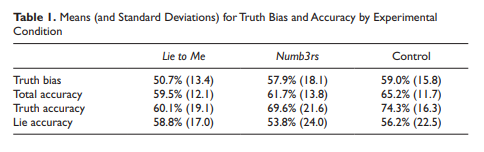</center> <center><sub>Only differences in truth bias and truth accuracy turned out to be statistically significant.</sub></center> <h3>True nature of real time lie detection</h3> The series is based on the assumption that it is possible to effectively detect lies in real time on the basis of careful observation and rapid analysis of behaviour, and that there are people with the natural gift of detecting lies. Contemporary studies do not support any of these claims. Bond and DePaulo studies from 2006 and 2008 show that the effectiveness of people in detecting lies is only slightly better than accidental guesswork, and that there are no significant differences in this ability in the population, even in professions that often have to deal with lies, such as policemen. A study by Frank and Feeley in 2003 showed that professional body language training only slightly improves the effectiveness of detecting lies in real time by 4%. <h3>Possible social impact</h3> Researchers at Michigan State University concluded that "Lie to Me" is misleading, giving the impression of dealing with scientifically proven methods of detecting lies, which can lead to an unjustified increase in the sense of competence in this area. This in turn may cause more frequent erroneous attribution of lies in everyday situations. Scientists also point out that this TV drama can give the impression that law enforcement officials are effectively trained to detect lies, with negative social consequences such as excessive confidence in the effectiveness and methods of law enforcement in detecting terrorism based on body language. </div> --- ###### Literature <sub>*Bond Jr, C. F., & DePaulo, B. M. (2006). Accuracy of deception judgments. Personality and social psychology Review, 10(3), 214-234.* *Bond Jr, C. F., & DePaulo, B. M. (2008). Individual differences in judging deception: Accuracy and bias. Psychological bulletin, 134(4), 477.* *Frank, M. G., & Feeley, T. H. (2003). To catch a liar: Challenges for research in lie detection training. Journal of Applied Communication Research, 31(1), 58-75.* *Levine, T. R., Serota, K. B., & Shulman, H. C. (2010). The impact of Lie to Me on viewers’ actual ability to detect deception. Communication Research, 37(6), 847-856.*</sub> --- </div> --- https://steemitimages.com/DQmf73yPMua6pUfHX4QJ3zgkffnddNTS1QscKovcFzbqBoW/SteemSTEM-1-New.gif --- <div class="text-justify"> <sub>SteemSTEM is a community driven project which seeks to promote well written/informative Science Technology Engineering and Mathematics postings on Steemit. More information can be found on the @steemstem blog. For discussions about science related topics or about the SteemSTEM project <a href ="https://discord.gg/6jxvGeB">join us on steemSTEM Discord server</a>.</sub> </div>
👍 saunter, jakipatryk, edimor, onufry, pibyk, astromaniak, bocik, whd, curiosit, astronomyizfun, remlaps2, remlaps, bowess, santarius, dysfunctional, robotics101, hanki, mciszczon, antoniojoseha, barcisz, abigail-dantes, vadam134, petr.ryjkov, rozku, suesa, steemstem, anarchyhasnogods, justtryme90, lemouth, flurgx, planetenamek, felixrodriguez, simplifylife, mayowadavid, erodedthoughts, enzor, sco, adetola, mittymartz, terrylovejoy, rionpistorius, de-stem, derbesserwisser, leczy, ksolymosi, lafona-miner, mountain.phil28, monie, deutsch-boost, croctopus, doctor-cog-diss, biomimi, thevenusproject, borislavzlatanov, ertwro, juanjdiaz89, jamhuery, the-devil, zeeshan003, foundation, pangoli, lamouthe, himal, physics.benjamin, sakura1012, rachelsmantra, alexdory, kerriknox, nitesh9, pearlumie, gra, pseudojew, chloroform, ugonma, dexterdev, rjbauer85, suravsingh, whileponderin, dna-replication, kryzsec, curie, liberosist, meerkat, awesomianist, markangeltrueman, tantawi, locikll, aboutyourbiz, howtostartablog, cryptokrieg, amavi, chimtivers96, pacokam8, dber, musicayfarandula, anwenbaumeister, dashfit, sethroot, bobdos, wanderingdanish, hendrikdegrote, jordanx2, niouton, ejhaasteem, boynashruddin, misterakpan, clweeks, victorcovrig, blessing97, gentleshaid, kenadis, mountainwashere, carloserp-2000, kushed, hadji, apple96, pharesim, serylt, infinitelearning, positiveninja, wdoutjah, spederson, michelios, thinknzombie, massivevibration, onartbali, benleemusic, steemulator, cgbartow, torico, coloringiship, bennettitalia, emotionalsea, vanessahampton, shaff.aff, theunlimited, ceybiicien, for91days, gtg, michalx2008x, ana-maria, nero12, dropahead, nicniezgrublem, barvat, a-steemdefleague,