Dickens The Inimitable
history·@truthtellerhere·
0.000 HBDDickens The Inimitable
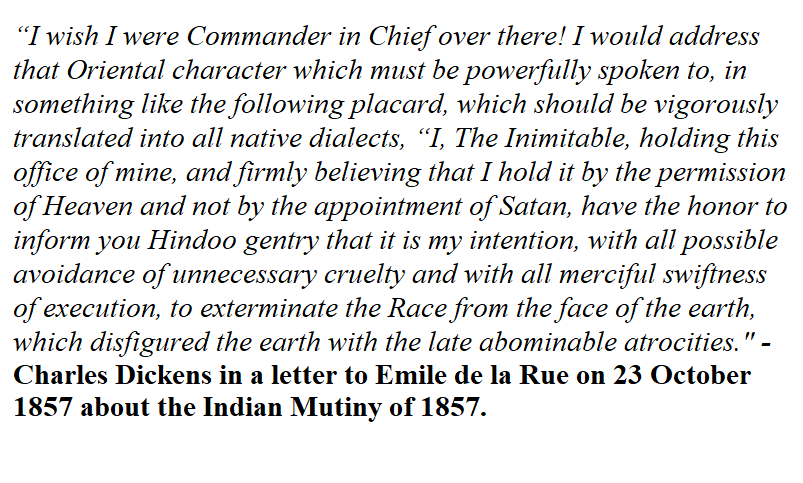 In what some Indians called the first war of Independence (1857, Indian Mutiny), among the many sieges was the siege of Cawnpore (now Kanpur), 250 miles from Delhi. On 27 June, Sir General Hugh Wheeler’s bedraggled garrison climbed upon a number of thatched-roof boats, guided in by helpful mutineers. As the boats prepared to depart, flaming arrows set the thatched roofs ablaze and soon bodies - shot or beheaded - clogged up the shallow waters. Those who tried to swim to the opposite shore were caught and killed. Among those killed was Sir General Hugh Wheeler who smuggled out a plea to another British garrison located at Lucknow, 50 miles away, ‘Surely we are not to die like rats in a cage?’ The Lucknow garrison, however, was also under siege. Two days after the violence, a company of British troops under the command of General Sir Henry Havelock captured the city. Whether involved or not, Indians had to lick the blood stains of the dead; Hindus were forced to eat beef, Muslims pork. The latter were tied up in pigskin before being executed. Many Indians who played no part in the violence were summarily executed — the preferred method of execution was to be blown to pieces with the muzzle of an artillery gun. Dickens — a nightmare for a people who alone had been excluded from the 'sympathizing heart' of this powerful friend of the oppressed — has painted a vile prejudice against the despised such as Jews, Hindus, Black people, Native Americans, etc. Dickens settles for stereotypes and sweeping generalisations about peoples he had never encountered and — according to Professor Sian Griffiths — exhibits many of the same uncivil qualities he attributes to savages. 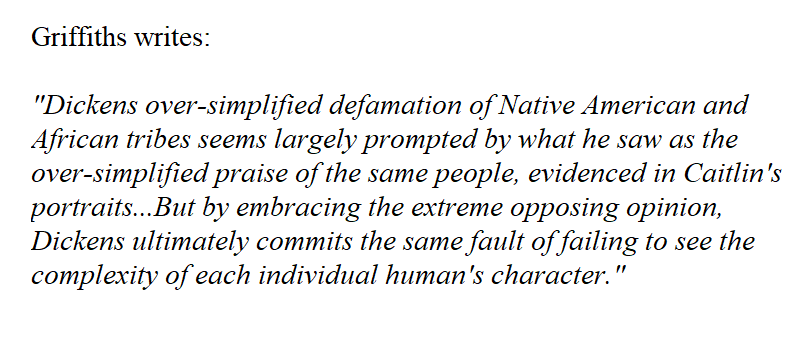 Modern historians have vindicated John Rae's report published in The Times about the Inuit discovery of the lost Franklin Expedition whose crew resorted to cannibalism; Dickens, in addition to Franklin's widow, refused to accept the report and accused others principally the Inuit of being liars. John Rae disputed with Dickens and defended the Inuit as *"a bright example to civilized people"* and compared them favourably to the undisciplined crew of Franklin. *"Men say, 'This is a bad Greek, but there are good Greeks. This is a bad Turk, but there are good Turks.' Not so with the Jews ... they take the worst of us as samples of the best ..."* said a character of Dickens' creation in **Our Mutual Friend**. In **American Notes**, Dickens presented a black coach driver of a grotesque description with the focus on the man's dark complexion and way of movement, which to Dickens amounts to an *"insane imitation of an English coachman"*. Dickens maintained that the Native Americans were dirty, cruel, and constantly fighting. In **The Noble Savage**, Dickens' attitude towards Native Americans is one of condescension and the arrogance of European colonialism. Dickens touts the superiority of European culture and civilisation, while denouncing savages as murderous. The sun never set, said the British, on the British empire. But the sun set everyday. <p>REFERENCES</p> http://www.countercurrents.org/polya100212.htm https://en.wikipedia.org/wiki/Racism_in_the_work_of_Charles_Dickens http://www.historyinanhour.com/2012/06/27/siege-of-cawnpore-summary/
👍 truthtellerhere, qurator, ethandsmith, cyclope, celizbrwn, samueljohn1999, steemd1, lordkalki8, steemcondenser, szokerobert, jbbasics, freedomtrader, stuffy, fronttowardenemy, scrooger, theleapingkoala, boomerang, steemdiffuser, buti95, anwarlabu, raised2b, smartsteem, pranishg, towhidkhondoker, rightscomet, tokenlingual, rwelectric, champion69, ihodlcrypto, erodedthoughts, cryptomaniac6, swissmade1, nicolecellbotics, kim3ra, rensd, jpapa, saint0211, thegreatlife, hns101, lesuelrs, overanalyzed, cryptoradu, bc00054, sleepingom, sloper, glasiad, cmsaagii, dzi, tojan97, rotorbird, jerome-colley,